
Our hydrogen plasma reactor melts, reduces, atomizes and quenches in a single continuous step, turning scrap and oxides into spherical premium powder, with water as the only by-product.
Every stage below is observed, modeled and corrected in real time by our own physics AI model, from plasma temperature in the melt zone to quench rate at the nozzle exit.
Plasma at ~5,000 K melts the feedstock; hydrogen dissociates into atomic H.
Atomic hydrogen strips the surface oxide. Oxygen leaves as water, not CO₂.
Supersonic gas expansion breaks droplets to target particle size.
Adiabatic cooling freezes chemistry and spherical shape in milliseconds.
An inert chain from reactor to sealed vessel. Powder never sees air.
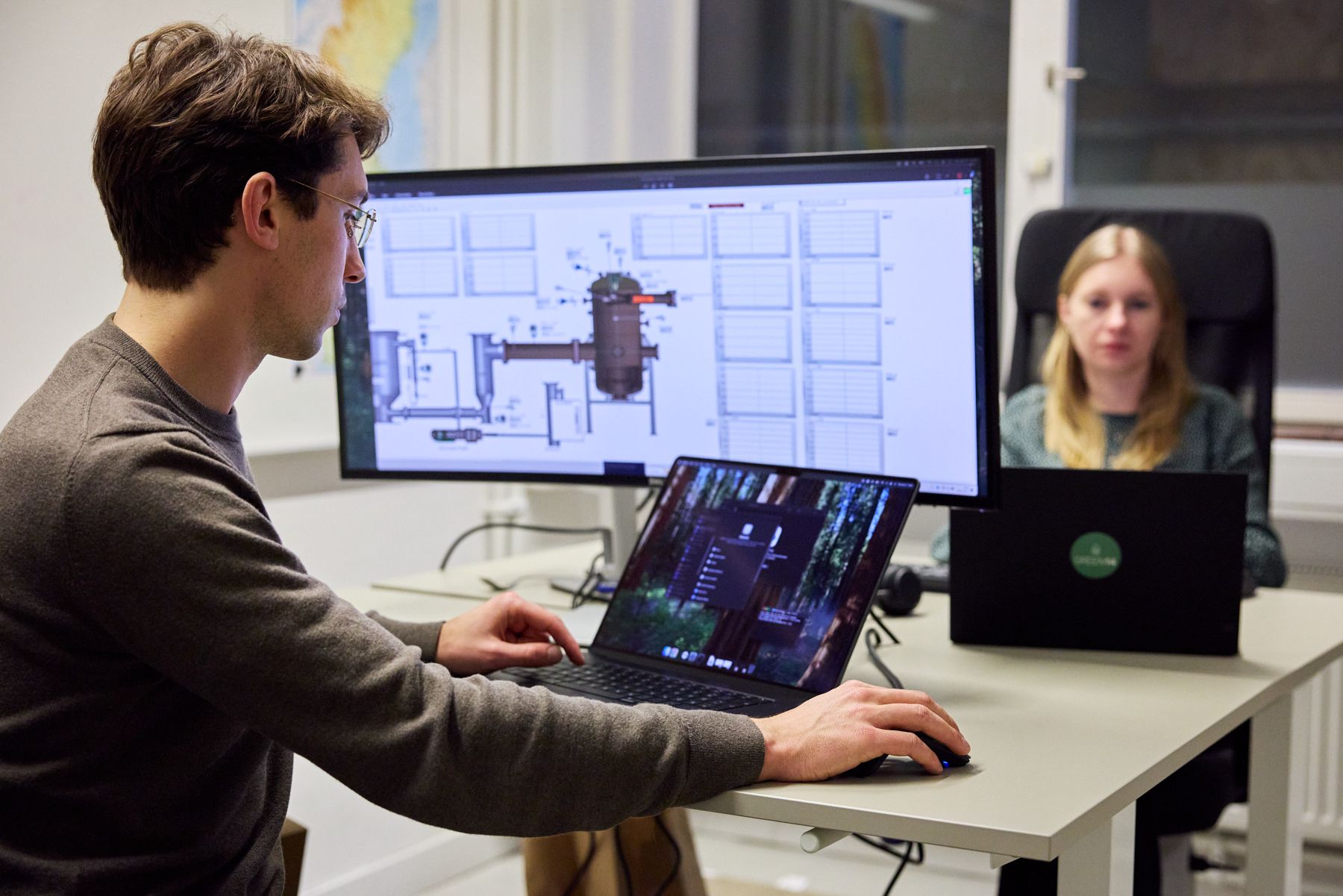
Frontier AI has read the internet. It hasn't run a hydrogen plasma reactor. The physics that matters here lives in experiments, not in text, and high-fidelity simulation is too slow to steer a live process. So we built our own loop:
Our own fast physics AI sweeps several thousand reactor configurations in seconds, grounded in conservation laws.
Promising candidates are checked in COMSOL: plasma-particle tracing, heat diffusion, and reactive transport at high fidelity.
The reactor executes only the configurations the AI judges most informative. Every run is a real encounter with the plasma.
Each run produces gigabytes of plasma, particle and thermal data. Models retrain on it, sharpening the physics AI model and the simulation priors. Better data, better models, better reactor.
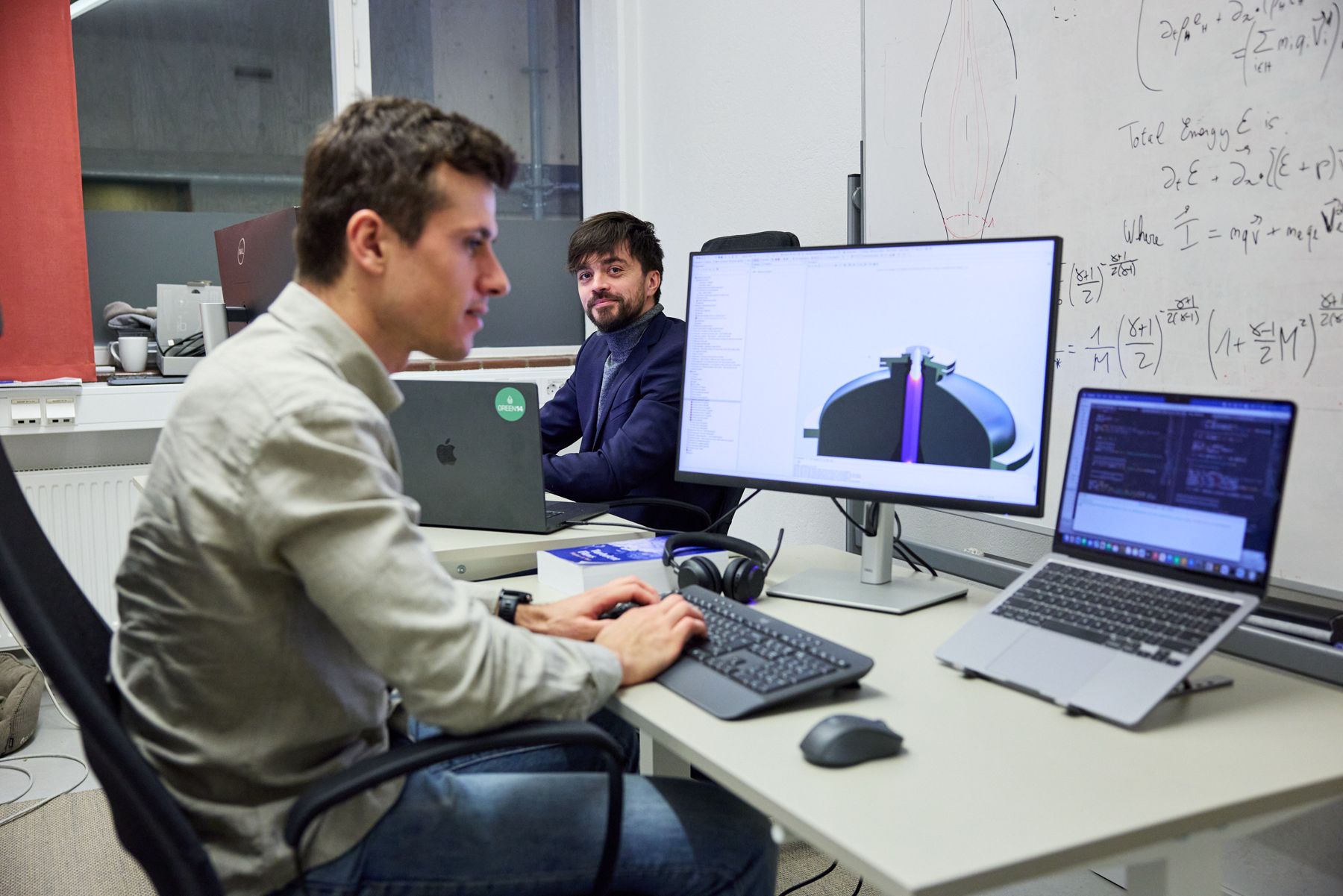
The result is a digital twin that finds the settings for target spec, picks the next most valuable experiment, and de-risks every scale-up step before hardware is built.
Figures below reflect our Ti64 validation case; economics and footprint vary by material.
| Conventional | GREEN14 | |
|---|---|---|
| Feedstock | Virgin bar, €50+/kg | Circular scrap, €1–5/kg |
| Process | Multi-step, 1920s atomization physics | One continuous step |
| Carbon | ~100 kg CO₂e/kg powder | Target ~18 kg CO₂e/kg |
| Waste | 30–50% off-spec, exported or downcycled | Closed loop, zero waste powder |